






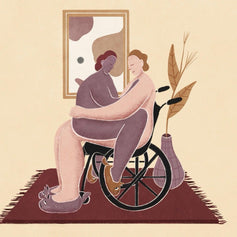








Tory Howell (she/they) is the founder of Somatic Connect, a practice that specialises in inclusive, queer-affirming embodied counselling and somatic relationship coaching. Tory works with clients seeking a deeper connection with themselves and others through a body-oriented approach to therapy; helping them to understand and shift patterns from the inside out. Offering online and in-person sessions, right here at Passionfruit, we asked Tory about their practice to better understand who might benefit.
But first, what does ‘somatic’ mean? And what is embodied counselling?
A somatic practice involves working with the body by using practical and physical techniques. Embodied counselling is designed to help strengthen the bond between body and mind, bringing focus to what’s happening physically to invite insight and shift internal patterns and behaviours.
“Somatics as a practice is moving from solely talking and thinking, into doing, feeling and experiencing what is going on for you in the moment. This could be through movement, breath, touch, guided inquiry, visualisation, tuning into your senses – the possibilities are endless.” – Tory Howell, Somatic Connect

Passionfruit: Tory, thanks for chatting with us. Please introduce yourself to our readers, and tell us about what first attracted you to somatics?
Tory Howell: Hello, I’m Tory (she/they). I’m a queer, somatic practitioner based in Melbourne, Australia. I’ve been exploring the body-mind connection for most of my life, even before realising what I was doing.
I’m a naturally curious person who often answers, “I’m in” when asked to try new things. Over the years, this curiosity introduced me to all sorts of spaces — fine arts, yoga and meditation, embodiment and sexuality, kink, jewellery-making, sexology, and many queer spaces. Some were fun, some unusual, and some confronting, but all of them taught me something about being human. So while I’ve worn many hats, working across graphic design, massage therapy, and even horticulture, my openness to trying new things is what actually led me to somatics.
It became the thread that brought everything together; a new way to explore myself that felt familiar, and supported me to move through things I’d felt stuck in for a long time. I’ve completed formal education at the Institute of Somatic Sexology (AU and the Somatica Institute (USA), and am a member of the Somatic Sex Educators' Association of Australasia (SSEAA). I continue to learn from the practitioners, peers, and sexologists I admire, as well as attending workshops, talks, reading, listening and feeling.
P: Many of us live ‘in our heads’, because reality can, for many reasons, feel ‘unsafe’. How does the somatic approach bring us into the physical world?
TH: Most of us have become very skilled at being in our heads or verbalising things. Here, feeling, allowing, processing or being with emotions is foreign. Somatics is about practicing being present with your experiences, gaining insight and understanding about them and from practically exploring things in-session and through take-home practices moving into having choice, rather than reacting when things come up both in-session and in daily life.
Speaking from my own mental health experiences, the real shift began when I started incorporating body-based practices with the understanding gained from talk therapy. I found that this work was incredibly helpful at providing me with a deeper understanding of my experiences and behaviours. Working somatically has helped me restore alignment and connection within. I’ve found more room to be myself – to be more present, more authentic, and more able to meet challenges with a greater awareness and ease than ever before.
P: What do you wish more people knew about somatics?
TH: That it isn’t some cure-all for living a worry-free life. And that although it’s a buzzword coming up more often, somatics is not new. Somatics is more about being on board with life's ups and downs; that accepting the chaos and the joy can be a relief and even enjoyable. When we restore the alignment between our body’s nervous system, emotions and thoughts, we can begin to live with more agency, more freedom.
Somatics has always been part of being human — we just didn’t call it that. Things like yoga, dancing, music, or consensual practices like BDSM, are all invitations to drop into the body and connect with what we’re feeling in our internal world. They help us regulate, express and process emotion, feel more connected to ourselves and others. In a lot of ways, somatic work is really just remembering what the body already knows.

P: Who might benefit most from somatic coaching or embodied counselling?
TH: If you’ve found talk therapy helpful but feel a little stuck, if you find you’re feeling anxious, stressed, numb, or any emotion often enough that it’s overwhelming, or if you feel the desire to connect to yourself more than you do right now, this approach could be beneficial for you.
P: Finally, could you please expand on your service offering – what’s the difference between each type of session?
TH: So, I am super excited to be part of the team at Passionfruit in Fitzroy, where I am offering in-person embodied counselling and somatic coaching sessions in the private consultation space. I also offer online sessions via Somatic Connect for anyone interested but located elsewhere. My experience covers things like: identity, sexuality, intimacy, anxiety, stress, grief, communication, embodiment, wellbeing, boundaries, life transitions, and self-esteem.
In an embodied counselling session, alongside talking, we pay attention to what’s happening in your body – things like sensations, breath, movement, and emotional responses. This helps us understand patterns from the inside out, rather than just analysing them. It can support greater self-awareness, regulation, and meaningful change that feels integrated, not forced.
I also offer somatic intimacy and relationship coaching for individuals and couples. This work supports people who want to build emotional awareness, navigate conflict more easily, and deepen intimacy and pleasure, along with cultivating an authentic, grounded connection to yourself.
Both offerings are experiential, in that sessions evolve from talking and thinking into doing. Practical work in-session allows for real time learning, using body-based tools to help you feel safer, more present, and more connected – both with yourself and with others.
I created Somatic Connect to be a queer-affirming, shame-free space where you don’t have to fit into any boxes. All bodies, genders, sexualities, relationship styles, and neurotypes are welcome; whether you’re kinky, vanilla, a SW, or somewhere outside labels and binaries altogether – you are welcome.
Somatic Connect offers a free 15-min introductory call. Book in to discuss how embodied counselling and somatic intimacy coaching can support your pleasure practice.
Keep an eye out for Tory’s upcoming workshops, focused on how we experience or express intimacy, and how we explore our core desires.




