






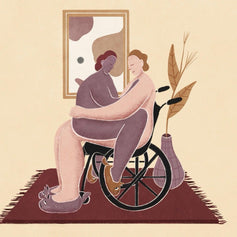








For a while there, our concerns and curiosities about sex and relationships were either discussed among our closest friends or medical practitioners. Today, we’re blessed to be surrounded by more qualified experts than ever before, who are skilled at helping us navigate these topics with confidence. Tori Bellentina is one such expert.
A talented handywoman, gamer, and vacuum-repair extraordinaire, Tori is a functional sexologist (Curtin University) and the manager of Passionfruit in Melbourne. We spoke with the multi-hyphenate about her practice and why everyone should see a sexologist at least once.
Passionfruit: Tori, we’re so used to you sharing helpful advice in-store, so thanks for joining us online for a more casual chat. Would you please introduce yourself to any readers who may not know you yet.
Tori Bellentina: Hi, I’m Tori (she/her). I’m a functional sexologist and the manager of Passionfruit in Melbourne. My work focuses on the practical side of sexual health such as helping people navigate sexual wellbeing through functional supports, assistive devices, and evidence-informed product use.
I have a particular passion for the efficacy of lubricants and how different formulations interact with the body, especially in cases where people are experiencing skin sensitivities, vaginal or vulvar irritation, or sexual pain. Much of my work centres on helping people find practical solutions that allow them to maintain pleasure, intimacy, and sexual wellbeing through different stages of life and health.
P: How would you describe your current relationship with sexology?
T: My sexological practice has evolved quite significantly over the years and has taken a somewhat different path from many of my peers. While I value my client consultations, I find that I particularly thrive in educational and clinical support settings. A large part of my work now involves teaching and professional development within allied health spaces. I regularly deliver in-services at hospitals, present at conferences, and develop training sessions for healthcare professionals around sexual rehabilitation and functional sexual health supports.
Working in a hands-on environment at Passionfruit has also given me a very unique perspective within sexology. Being in daily conversation with people about their sexual health and the products they are using allows me to see patterns and practical solutions that might not always appear in purely academic settings. I’m constantly exposed to new tools, products, and adaptations, which allows me to develop practical “hacks” and strategies that can make a real difference in people’s lives.

P: What first inspired you to pursue sexology?
T: My pathway into sexology came through an interesting combination of personal experience and professional background. Earlier in my career I worked within plastic surgery and skincare, and I also grew up managing significant skin sensitivities myself. That meant I developed a strong interest in how products are formulated and how they interact with the skin and body.
When I began working at Passionfruit, I became particularly interested in lubricants. I started researching their ingredients and how different formulations affected the body, especially in relation to irritation, vaginal health, menopause and sexual discomfort. Over time I began noticing correlations between certain sexual health concerns and the types of lubricants people were using.
The deeper I went into the science and research, the more I realised there was a significant gap in accessible, practical information about these products. I became very passionate about sharing that knowledge with people. Eventually I decided to formally study sexology so I could support the work I was already doing with a strong academic foundation.
P: Now, as a practicing sexologist, what kinds of services do you offer?
T: My consultations focus largely on functional sexual health and sexual rehabilitation. I work with many clients experiencing vulvar or dermal conditions that contribute to sexual pain disorders such as Genito-Pelvic Pain/Penetration Disorder (GPPPD). These issues can arise from a variety of factors including chemotherapy, radiation treatment, menopause or medically induced menopause, as well as recurrent conditions such as thrush or bacterial vaginosis that can eventually lead to painful sex.
I also work extensively with prostate cancer patients and individuals recovering from prostate surgery. This includes supporting erectile rehabilitation, teaching the safe and effective use of vacuum erection devices, and helping people rediscover pleasure and intimacy after surgical interventions.
Accessibility is another important aspect of my practice. Many people with disabilities or additional physical needs find that standard sexual wellness products aren’t designed with them in mind. I work with clients to identify their specific needs and then help source or adapt tools that make pleasure and intimacy more accessible.
Alongside these areas, I also see clients who are navigating relationship or intimacy concerns. Often these challenges are connected to underlying physical or sexual barriers, and my role is to help people explore practical pathways forward.
"I think we are beginning to see a cultural shift where sexology is increasingly recognised as an important part of a multidisciplinary allied health team."

P: Considering these barriers, what do you wish more people knew about sexology and its ability to enhance their lives?
T: I think we are beginning to see a cultural shift where sexology is increasingly recognised as an important part of a multidisciplinary allied health team. I would love to see that recognition continue to grow.
In parts of inner-city Melbourne this collaborative approach is becoming more common, but in rural and regional areas access to sexual health support is still extremely limited. Sexual wellbeing is a significant part of quality of life, particularly for people recovering from illness, injury, or medical treatments.
Unfortunately, many clients tell me they were never asked about their sexual recovery, or that when they did raise the topic they were dismissed or told they should simply be grateful to be alive. While survival is obviously important, sexual wellbeing is also part of feeling whole again after medical treatment.
Another important point is that sex is often narrowly defined as penetrative intercourse. In reality, sexuality is much broader than that. Pleasure, intimacy, and sexual expression can be adapted and reinvented in ways that suit each individual body and circumstance.
P: So, why do you think people might put off seeking support in these areas?
T: Embarrassment is certainly one of the most common barriers. Many people feel uncomfortable discussing sexual concerns, even when those issues are significantly affecting their wellbeing.
Another major barrier is misinformation. Some people have been told that nothing can be done for their situation, or they assume there are no options available to them.
For people with disabilities or acquired disabilities, funding systems can also create barriers. Navigating support structures such as the NDIS can be complex, and there can unfortunately still be attitudes that infantilise people with disabilities or suggest that sexual wellbeing is not a valid area of support. These barriers can make it much harder for people to access the education and assistance they need.

P: Who might gain the most from your consultations?
T: People with complex sexual health needs often benefit the most from my consultations, particularly those who feel they need support reimagining intimacy or rebuilding their sexual wellbeing after medical changes.
Individuals experiencing ongoing vulvar health concerns, painful sex, or skin-related sexual issues can find it particularly helpful to explore practical solutions and product choices that support their bodies.
And of course people going through cancer treatment or recovering from cancer-related surgeries, especially where sexual function has been affected. In these situations, a sexologist can help people navigate both the physical and emotional aspects of sexual recovery.
P: Finally, what’s one thing you wish people knew to improve their pleasure practice?
T: If there is one simple change that can dramatically improve many people’s sexual experiences, it’s using a high-quality lubricant.
Research suggests that a large proportion of lubricants on the Australian market are not ideal for vaginal or anal use due to their formulation. (Read more about the science of lube here.) Many people have had negative experiences with lubricants simply because they were using products that weren’t particularly body-friendly.
When people find a lubricant that is well-formulated and compatible with their body, it can significantly enhance comfort, pleasure, and overall sexual experience. It’s often one of the easiest and most effective improvements someone can make.
P: Where can people find you and access your services?
T: Alongside my private consultations, I regularly provide training and professional development for allied health professionals who want to better support their patients’ sexual wellbeing.
I’m always happy to arrange in-service sessions or educational workshops for healthcare teams who are interested in learning more about sexual rehabilitation, sexual aids, and practical ways to integrate sexual health into patient care.
For updates on my current work, conference presentations, and insights from my private practice, you can also follow my work on Instagram at @tori.bellentina.sexologist.




